Why Paint Correction Comes Before a Ceramic Coating
A coating is clear, hard, and built to stay, so the paint underneath had better look the way you want it to.
October 17, 2026 · 4 min read
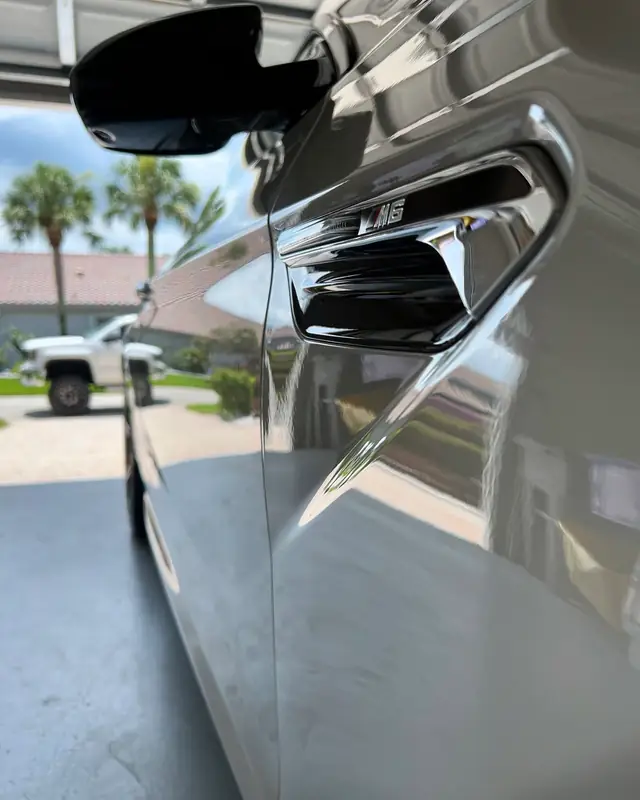
If you've decided to put a ceramic coating on your car, there's a question to settle before anything gets applied: what will the paint look like when it's sealed in? A coating is clear, hard, and built to stay put. That's the whole appeal. It also means that whatever is on the paint when the coating cures is what you'll be looking at for a long time. Most questions about coatings turn out to be questions about the paint underneath.
Think of a coating like a pane of glass over a photograph. If the photo has scratches, the glass doesn't remove them. It makes them permanent residents. Swirl marks, light scratches, and dull patches don't disappear under a coating. Because the surface becomes slick and glossy, many flaws actually show up more clearly, especially in direct Florida sun. Correction first and coating second is the order that makes sense, and it's the order a careful detailer will insist on.
Where swirl marks come from
Swirl marks are thousands of fine scratches in the clear coat, the thin transparent layer that sits on top of your color. They come from everyday life: automatic washes with brushes, dry towels dragged across dusty paint, a quick wipe with the wrong cloth, even a dealer lot wash before you took delivery. Dark cars show them most, which is why black paint gets so much attention, but a white truck has them too. You just see them at a different angle.
Under a single point of light, like the sun at noon in Boca Raton or a flashlight in a garage, swirls fan out in spiderweb patterns. Once somebody points that pattern out, most owners can't stop seeing it.
What polishing actually does
Polishing doesn't fill scratches with something that washes out later. It levels the clear coat by removing a very thin amount of material until the surface is flat again, so light bounces back in one clean direction instead of scattering. That's why a corrected panel looks deeper and wetter than it did before. The color didn't change. The surface just stopped scattering the light.
It also means correction is a skill, not a product. Too aggressive, and you remove more clear coat than you needed to. Too timid, and the swirls are still there when the coating goes on. David Morse of Reflect says he looks at this work more as an art form than as cleaning cars, and that attitude shows up in exactly this balance, panel by panel.
Single-stage correction or something heavier?
Not every car needs the same amount of work. A single-stage correction uses one polishing step to remove light to moderate defects and bring back gloss. It suits newer cars, cars that have been washed carefully, or paint that was never badly neglected. A heavier correction adds more steps for deeper scratches and accumulated wash damage, and it's a bigger job.
Which one your car needs depends on the paint, not on what you'd like it to be. Some factory finishes are soft and mark easily. Others are harder and take more effort to level. A good detailer tells you what they see before they start. Here are questions worth asking:
- How deep are the defects on my car, and will a single-stage correction clear most of them?
- Is any area too thin to polish safely, and how do you check?
- Will you show me a panel under the inspection light before and after?
- What do you recommend for the spots that won't fully clear, like a scratch you can catch with a fingernail?
- Who does the actual polishing on my car?
Inspecting paint under real light
You can't correct what you can't see. Garage fluorescents and overcast skies hide a lot of defects, which is why a proper inspection uses strong, direct light moved across each panel at different angles. Done right, it shows the swirls, the haze, the water spots etched into the clear coat, and the places where an earlier polish job went sideways.
You can do a rough version at home. Park in direct sun, or hold a bright flashlight close to the paint at a low angle, and look at the hood and doors. If the surface looks like a spiderweb, you've got swirls. If it looks clear and deep, you're in better shape than most. Take a few photos so you can talk them through with your detailer.
Water spots deserve a note. Sprinkler water in Palm Beach County leaves mineral deposits on paint, and baked by the sun they can etch into the clear coat. Light ones polish out. Deep ones may only improve. An honest detailer will tell you which is which.
Putting it together for your car
The sequence for a coating job done properly is simple to say: wash and decontaminate, inspect, correct, then coat. Skipping the middle steps is how people end up with a glossy coating over dull, scratched paint and a feeling that the money didn't do what they hoped.
Reflect Auto Detailing & Protection is solo owned and operated, and it's been that way since 2019. David Morse works on every vehicle himself. He's a System-X certified installer who also works with CeramicPro and IGL coatings, and he serves Palm Beach County, from Boynton Beach and Delray Beach to Boca Raton and Lake Worth, at your home or at the shop, by appointment.
If you're thinking about a coating and want to know what your paint needs first, call or text David at (561) 827-8663 and tell him what you drive.
Reflect Auto Detailing & Protection, (561) 827-8663
Call (561) 827-8663More articles
What Florida Sun and Salt Air Do to Your Paint
A plain look at UV, salt, and heat on a car's finish, and where a ceramic coating helps and where it doesn't.
How to Wash a Coated Car Without Undoing the Work
Your paint looks like glass right now. A few wash habits decide how long it stays that way.